the ou-tulsa center for studies in democracy and culture

Remember me.

The imprint of Duke's hand, hanging in the museum display
in the Moana Hotel, Honolulu.
The ink impression above of the hand of Duke Paoa Kahinu Mokoe Hulikohola Kahanamoku left an impression on me. It is as if he has reached out his hand, waiting for me to put mine next to his. There is something moving about it, touching. Standing in front of it the effect is immediate and real.
The hand print is in a small museum area on the balcony level of the Moana Hotel on Waikiki. The building was opened in 1901 and on a visit to Honolulu a few years ago to teach a class I went over to the hotel a couple of times for lunch on the broad veranda overlooking the beach. Wandering around the hotel one day after lunch, I found the small shrine, and Duke's handprint was the centerpiece of the exhibit. Duke was not the inventor of surfing, but he is the person a hundred years ago who did most to popularize surfing, and he probably remains the most famous surfer of all time. He is legendary in Honolulu, of course.
The print of Duke’s hand lead me to think about all the ways in which we long for permanence on this earthly plane even after we have departed for the next one. We long for eternity in the next world, but we would like to be eternal in this one too.
However certain may be our religious faith in a glorious afterlife, we also know that we don’t want to be forgotten by those we leave behind …and those left behind long to hold our memory as well, even after time fades the emotions surrounding the immediate impact of our loss.
The photos in this small page are ones that remind me of customs to commemorate the departed. Some are expressions from those who are still here, some are acts before death by those that wish to perpetuate their own memory.
This page is offered as a invitation to complete the meaning of memory and remberance of people we have lost.
(Left off these examples are buildings and places that bear the names of the donors that constructed them.)

Prof. Rodger Randle
The page is part of the Musées Privés series.
Duke on Waikiki beach, circa 1910-15
Well over a hundred years since the taking of this photo, we still remember Duke and we commorate what he represented in our society.
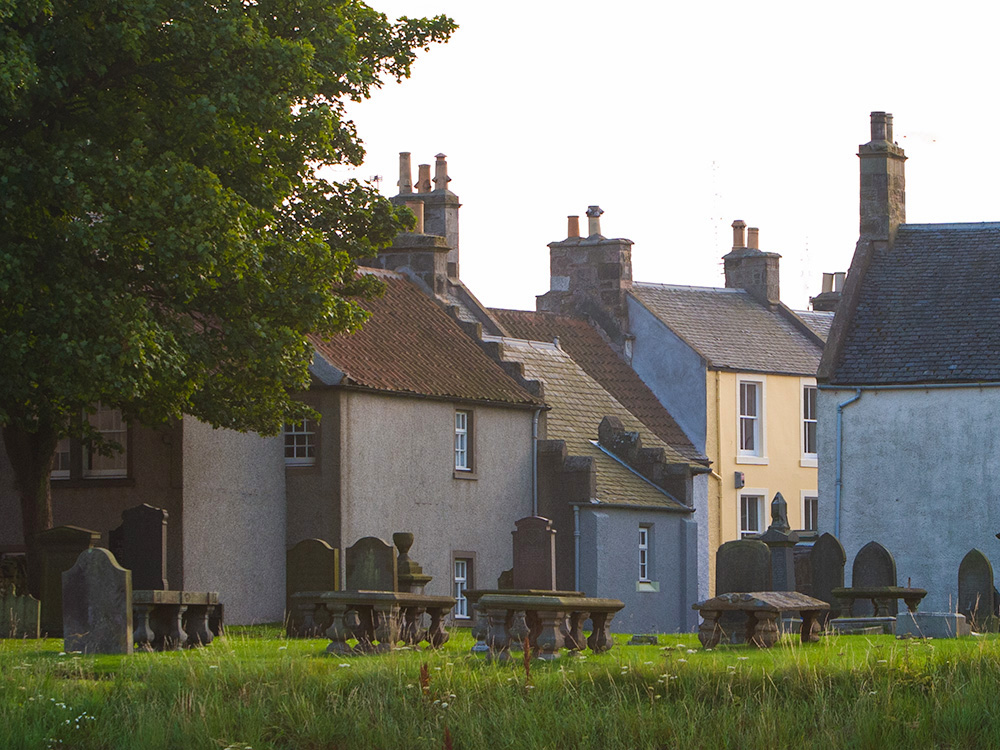
An old cemetery in Scotland:
Gravestones are the oldest and most traditional of permanent markers.
A leisurely walk through a cemetery with old gravestones and pausing to read the inscriptions leads us to reflection on our own mortality. It invites us to think on the people left behind and the emotions that our parting will inspite, or will not inspite, in them.
The photo of the graveyard looks a little artificial, like it has been retouched or processed. This is not the case. I wish I knew how to creat the look the picture has, but it has a look that my Canon camera prodced in certain kinds of twilight.
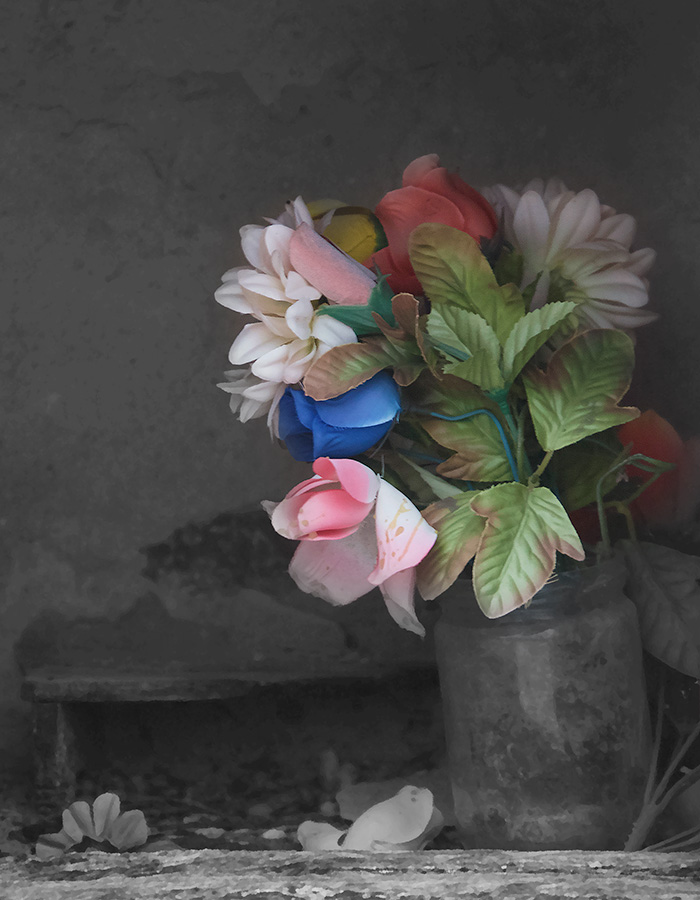
Cloth flowers in an old grave niche in the cemetery of a nearly-abandoned town in the Pampas of Argentina.
Even in an isolated place like this, people return to affirm their love for for people buried there. Even artificial flowers left to fade in the elements are a public testimony from the living to the love in which the departed is remembered.
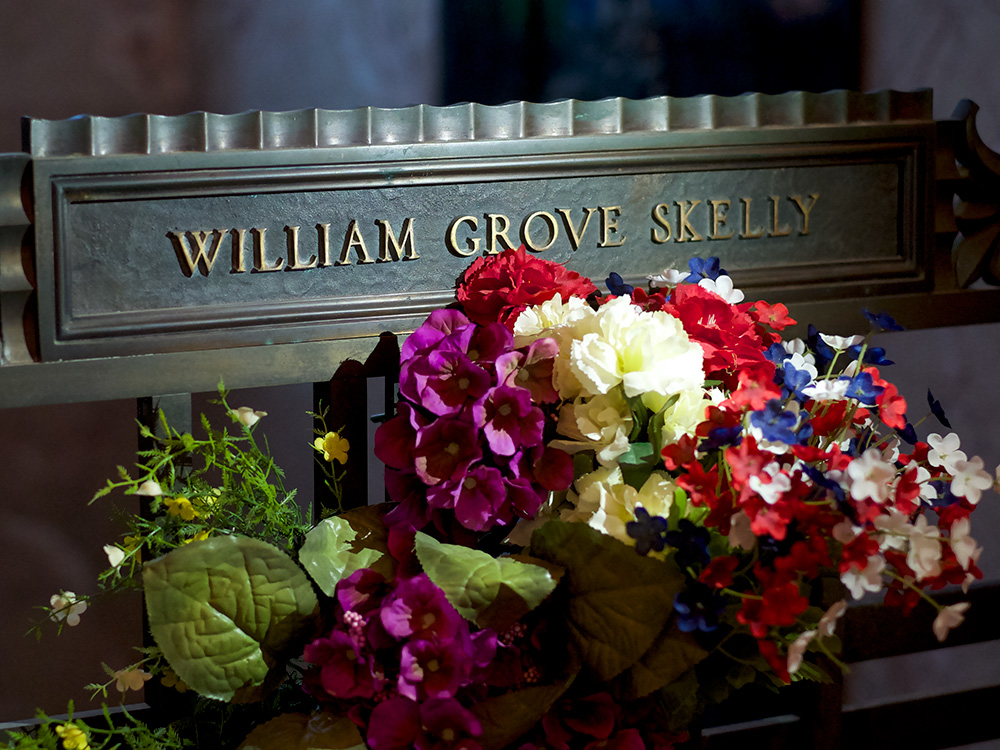
For many of Tulsa´s most important years of growth, Rose Hill on East Admiral was the main (White) cemetery. William Skelly's remains are in its mausoleum. On a visit to the mausoleum I was surprised to notice that there was a lovely boquet of artificial flowers at his crypt. He died in 1957, and the flowers I saw were certainly not decades old. Skelly does have grandchildren in Tulsa who might have a memory of him and could keep renewing his artificial boquets, but there is another possibility. I'm told that in the past affluent people often left a special bequest just to provide perpetual flowers at their graves.

This crypt in a mausoleum in a small village in rural Pakistan has been carefully covered with a blanket and flower petals have been sprinkled on top of it. Almost certainly the donor of the quilt was not a resident in the village, but probably someone living in a city like Lahore where jobs and inclomes exceed the possibilities of the little village. Relations between people in the cities and the ancestral villages from which the families come remain tight. Visits from the city to the villages may not be frequent, but they will not be rare. The villages wre where the forebearers are buried and it is the duty of the descendents to maintain the graves. The flower petals sprinkled on this crypt might be from a relative (or friend) in the village.
Everybody wants to go to heaven,
But nobody wants to die.
Loretta Lynn
You will eat bye and bye,
In the glorious land above the sky.
Work and pray, live on hay.
You's get pie in the sky when you die.
The IWW Songbook 1911
I met a traveller from an antique land
Who said: ― Two vast and trunkless legs of stone
Stand in the desert. Near them on the sand,
Half sunk, a shatter’d visage lies, whose frown
And wrinkled lip and sneer of cold command
Tell that its sculptor well those passions read
Which yet survive, stamp’d on these lifeless things,
The hand that mock’d them and the heart that fed.
And on the pedestal these words appear:
“My name is Ozymandias, king of kings:
Look on my works, ye mighty, and despair!”
Nothing beside remains: round the decay
Of that colossal wreck, boundless and bare,
The lone and level sands stretch far away.
Percy Bysshe Shelley
I am riding on a limited express, one of the crack trains of the nation.
Hurtling across the prairie into blue haze and dark air go fifteen all-steel coaches
holding a thousand people.
(All the coaches shall be scrap and rust and all the men and women laughing in the
diners and sleepers shall pass into ashes.)
I ask a man in the smoker where he going and he answers: “Omaha.”
Carl Sandburg
excerpt from: "Para Além da Curva da Estrada"
Se nós tivermos que chegar lá, quando lá chegarmos saberemos.
Por ora só sabemos que lá não estamos.
Aqui há só a estrada antes da curva, e antes da curva
Há a estrada sem curva nenhuma.
excerpt from: "Beyond the Curve in the Road"
If we have to arrive there, we will know when we get there.
For now we only know that we are not there.
Here there is only a road before the curve, and before the curve,
There is a road with no curve at all.
Fernando Pessoa
The photos on this page, with the exception of the beach photo of Duke, are © Rodger Randle.
OU Center for Studies in Democracy and Culture
Prof. Rodger A. Randle, Director
The University of Oklahoma Tulsa
4502 East 41st Street, Tulsa, Oklahoma 74135
E-mail:
randle@ou.edu
Click
here to visit our homepage.